

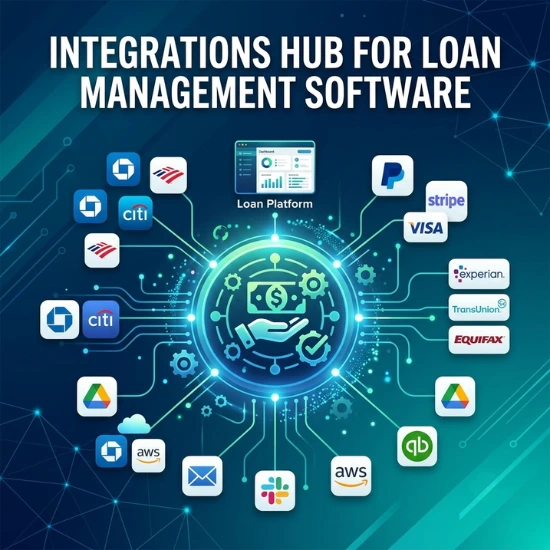
Explore Grin Technologies Integrations Hub for Loan Management Software. Connect Credit Bureaus, KYC, eSign, Payment, Messaging, CBS, and Bank APIs for faster digital lending
Integrations Hub
Modern lending is no longer powered by a single software application. Every successful lending business relies on multiple systems working together. Customer verification, credit checks, digital agreements, payment collection, accounting, banking, and customer communication all happen through connected platforms.
An effective Loan Management Software should become the central platform that connects these services securely and efficiently.
The Grin Technologies Integrations Hub is designed to simplify this process by providing a structured integration framework for lenders. Instead of manually transferring information between systems, organizations can automate workflows, improve accuracy, and reduce processing time.
This guide explains the integration categories supported by Grin Technologies, their implementation approach, and how they help lenders deliver faster, compliant, and more efficient lending services.
Why Integrations Matter in Digital Lending
Today’s borrowers expect instant responses, digital onboarding, online document signing, automated EMI reminders, and multiple payment options.
Without integrations, lenders often face challenges such as:
- Duplicate data entry
- Longer loan approval cycles
- Manual verification
- Delayed collections
- Higher operational costs
- Increased compliance risks
- Reporting inconsistencies
By integrating trusted financial services into a single platform, lenders can automate routine tasks while maintaining operational control.
Integrations Index
| Integration Category | Purpose | Status |
| Credit Bureau Integrations | Credit report verification | Live / Available |
| Digital KYC & eSign | Customer identity verification | Live / Available |
| Payment & eMandate | EMI collection automation | Live / Available |
| Accounting & Core Banking (CBS) | Financial synchronization | Available / Custom |
| Messaging Services | Customer communication | Live |
| Bank API Integrations | Banking connectivity | Available / Custom |
Note: Only verified integration categories are listed. Specific third-party providers are implemented based on customer requirements and approved integration availability.
1. Credit Bureau Integrations
Overview
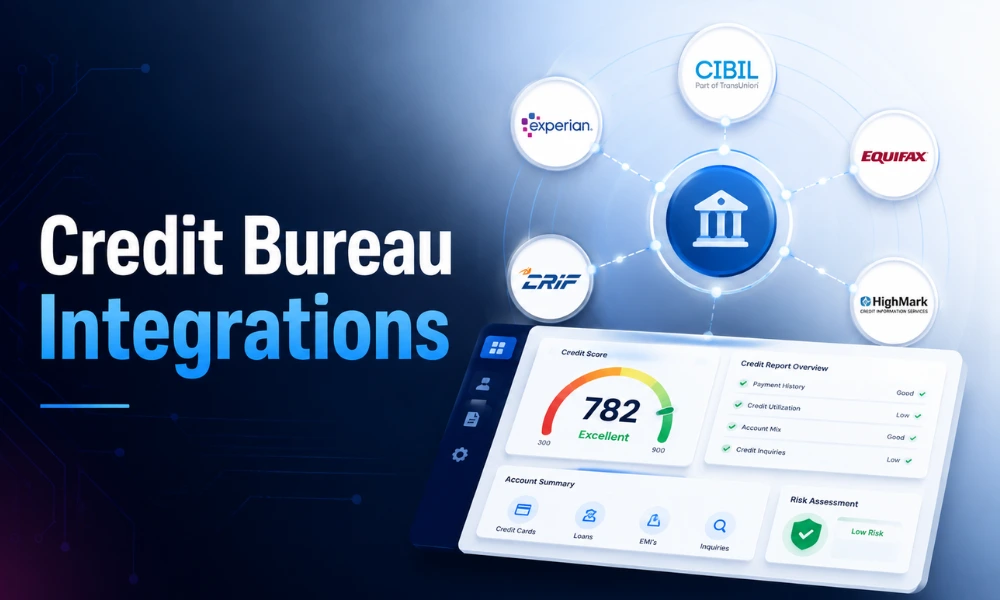
Credit bureau integration enables lenders to access borrower credit information during the loan assessment process. Instead of manually requesting reports, authorized users can retrieve credit data directly from the lending workflow, subject to customer consent and applicable regulations.
This helps improve credit evaluation while reducing turnaround time.
Typical Use Cases
- Loan eligibility assessment
- Credit score verification
- Existing loan obligation review
- Risk analysis
- Customer profile evaluation
Supported Workflows
Customer Application
↓
Customer Consent
↓
Credit Report Request
↓
Credit Assessment
↓
Loan Decision
Implementation Approach
The integration is implemented using secure APIs provided by authorized partners. Customer consent is captured before any credit information is requested. All API communications are encrypted and logged for audit purposes.
Integration Status
Status: Live / Available
2. Digital KYC & eSign Integrations
Overview
Digital onboarding has become an essential part of modern lending. Identity verification and document authentication help reduce paperwork while improving customer experience.
KYC and eSign integrations simplify customer onboarding by enabling digital verification and legally recognized electronic document signing where applicable.
Common Use Cases
- Customer onboarding
- Identity verification
- Address verification
- Digital agreement signing
- Paperless loan processing
Supported Workflows
Application Submitted
↓
Identity Verification
↓
Document Validation
↓
Digital Agreement
↓
Loan Approval
Implementation Approach
The platform securely exchanges information with approved verification providers through APIs. Identity validation and document signing processes are completed digitally while maintaining complete audit records.
Integration Status
Status: Live / Available
3. Payment & Mandate Integrations
Overview
Loan repayment is one of the most important stages in the lending lifecycle.
Payment integrations allow borrowers to make repayments through digital channels while helping lenders automate collections and reduce missed payments.
Common Use Cases
- EMI payments
- Recurring collections
- Payment reminders
- Collection tracking
- Settlement reconciliation
Supported Workflows
Loan Approved
↓
EMI Schedule Created
↓
Payment Collection
↓
Automatic Update
↓
Receipt Generation
Implementation Approach
Payment services connect securely with the loan management platform using APIs. Payment status updates automatically reflect within the customer account, reducing manual reconciliation work.
Integration Status
Status: Live / Available
4. Accounting & Core Banking (CBS) Integrations
Overview
Many NBFCs and financial institutions use accounting software or Core Banking Systems to manage financial records.
Integration helps synchronize financial transactions between operational and accounting systems.
Common Use Cases
- General ledger synchronization
- Financial reporting
- Loan accounting
- Interest calculations
- Reconciliation
Supported Workflows
Loan Transaction
↓
Accounting Entry
↓
Ledger Update
↓
Financial Reports
↓
Audit Support
Implementation Approach
Depending on the customer’s infrastructure, integrations can be configured through APIs, secure file exchange, or custom middleware.
Integration Status
Status: Available / Custom
5. Messaging Integrations
Overview
Effective customer communication improves repayment rates and enhances customer satisfaction.
Messaging integrations automate notifications throughout the loan lifecycle.
Common Use Cases
- OTP verification
- EMI reminders
- Loan approval notifications
- Payment confirmations
- Collection alerts
Supported Workflows
Customer Action
↓
System Trigger
↓
Notification Generated
↓
Message Delivered
↓
Customer Response
Implementation Approach
Notifications are triggered automatically from workflow events within the loan management platform.
Integration Status
Status: Live
6. Bank API Integrations
Overview
Bank API connectivity allows lenders to exchange information securely with banking systems for approved financial workflows.
These integrations improve operational efficiency while reducing manual processing.
Common Use Cases
- Bank account verification
- Fund disbursement support
- Payment status updates
- Account validation
- Financial data synchronization
Supported Workflows
Loan Approved
↓
Bank Request
↓
Transaction Processing
↓
Status Update
↓
Customer Notification
Implementation Approach
Integration is configured through secure APIs provided by authorized banking partners, based on customer-specific requirements and approvals.
Integration Status
Status: Available / Custom
How Grin Technologies Implements Integrations
Every lender has different operational requirements. For this reason, integrations are implemented using a structured process.
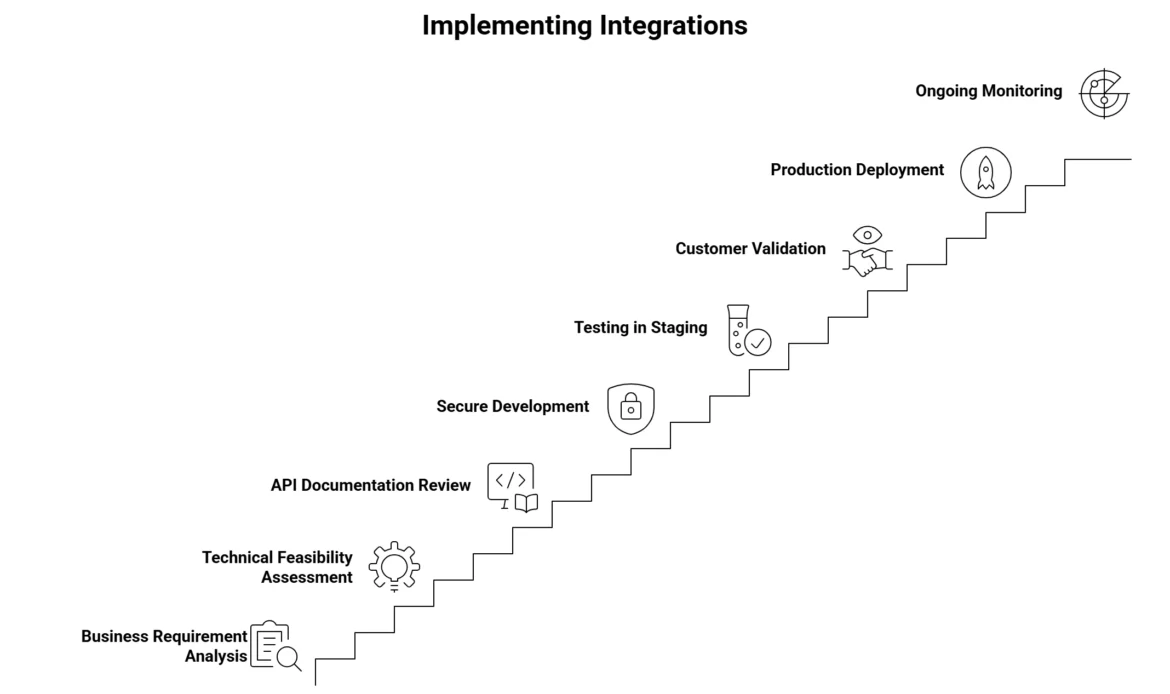
Step 1
Business requirement analysis
Step 2
Technical feasibility assessment
Step 3
API documentation review
Step 4
Secure development
Step 5
Testing in staging environment
Step 6
Customer validation
Step 7
Production deployment
Step 8
Ongoing monitoring and support
Security and Compliance
Every integration should be implemented with security as a priority.
Key practices include:
- Encrypted API communication
- Role-based user access
- Secure authentication
- Audit logging
- Controlled permissions
- Backup procedures
- Error monitoring
- Compliance with applicable regulatory requirements
Benefits of an Integrated Loan Management Platform
Organizations that adopt integrated lending systems often experience:
- Faster loan processing
- Reduced manual work
- Improved customer experience
- Better operational visibility
- Centralized information
- Improved reporting
- Easier reconciliation
- Enhanced compliance support
- Better collection efficiency
- Scalable lending operations
Who Can Benefit?
The integrations hub is suitable for:
- NBFCs
- Digital lenders
- Fintech companies
- Microfinance Institutions
- Cooperative Credit Societies
- Nidhi Companies
- Housing Finance Companies
- Gold Loan Providers
- Vehicle Finance Companies
- Consumer Lending Businesses
Why Choose Grin Technologies?
Grin Technologies focuses on building lending solutions that adapt to your operational needs rather than forcing you into fixed workflows.
Our integration approach emphasizes:
- Secure API architecture
- Flexible implementation
- Scalable infrastructure
- Configurable workflows
- Faster deployment
- Dedicated implementation support
- Future-ready platform architecture
Frequently Asked Questions
What is an integration hub in loan management software?
An integration hub is a centralized section that connects a loan management platform with external services such as customer verification, payments, banking systems, accounting software, and messaging platforms.
Can integrations be customized?
Yes. Depending on technical feasibility and partner availability, selected integrations can be implemented through custom development.
Why is API integration important?
API integrations reduce manual work, improve accuracy, automate workflows, and enable faster processing across multiple business systems.
Does every lender require the same integrations?
No. Integration requirements vary based on business model, regulatory obligations, operational processes, and technology infrastructure.
Are integrations secure?
Integrations should use encrypted communication, authentication controls, audit logs, and role-based permissions to protect sensitive financial information.
Request a Demo
Looking for a loan management platform that works seamlessly with your lending ecosystem?
Grin Technologies helps NBFCs, fintech companies, and digital lenders build connected lending operations through secure and scalable integrations.
Request a personalized demo today to explore how our Loan Management Software can simplify onboarding, credit assessment, payments, customer communication, and financial workflows.

