


Introduction
Choosing the right loan management software is one of the most critical decisions for any lending business. The right loan origination system (LOS) or loan servicing software (LSS) can streamline operations, reduce manual errors, ensure compliance, and boost customer satisfaction. This comprehensive guide will help you understand how to choose loan software that aligns with your business needs and scales with your growth ambitions.
Whether you’re a small startup lender, a credit union, auto finance provider, or commercial bank, finding the best lending management system requires careful evaluation of features, scalability, security, and cost.
The lending industry has changed dramatically over the last few years. Customers expect faster approvals, digital services, transparent communication, and convenient repayment options. At the same time, lenders are under pressure to manage risk, improve collections, maintain compliance, and reduce operational costs.
This is where the right Loan Management Software (LMS) becomes a game changer.
Whether you run an NBFC, microfinance institution, Nidhi company, vehicle finance business, gold loan company, consumer finance firm, or cooperative credit society, selecting the right software can determine how efficiently your organization operates.
Many lenders make the mistake of choosing software based only on pricing or attractive sales presentations. However, loan software is not just another business tool—it becomes the foundation of your entire lending operation.
In this guide, we’ll explore how to choose loan software that truly supports your business goals and future growth.
What Exactly Is Loan Management Software?
Loan Management software is a technology platform designed to manage the complete lending lifecycle.
Instead of handling customer applications, approvals, EMI calculations, collections, and reports manually, lenders can automate these processes through a centralized system.
A modern loan management platform typically handles:
- Customer onboarding
- KYC verification
- Loan application processing
- Credit assessment
- Loan approval workflow
- Loan disbursement
- EMI scheduling
- Payment tracking
- Collection management
- Recovery management
- Reporting and analytics
The objective is simple: reduce manual work, improve accuracy, and increase operational efficiency.
Why Your Software Choice Matters More Than Ever
Imagine approving hundreds of loans every month using spreadsheets, paper documents, and manual calculations.
The result is usually:
- Delayed approvals
- Data entry errors
- Poor customer experience
- Missed collections
- Lack of visibility
- Compliance challenges
Now compare that with an automated lending platform where every process is tracked in real time.
The difference is significant.
The right software doesn’t simply save time—it creates a scalable business model.
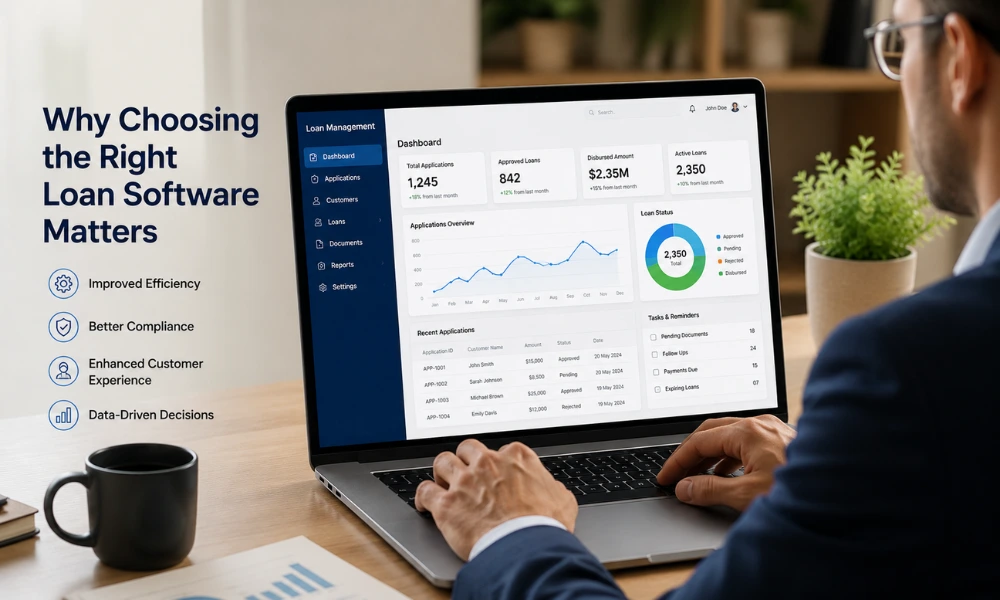
Step 1: Start by Understanding Your Lending Business
Before looking at software vendors, understand your own requirements.
Different lending businesses have different operational needs.
For example:
NBFCs Often Need
- Multi-product lending
- Credit evaluation workflows
- Compliance reporting
- Branch management
Microfinance Institutions Need
- Group lending support
- Field collection tracking
- Mobile collection applications
Nidhi Companies Need
- Member management
- Deposit management integration
- Loan and savings tracking
Consumer Finance Businesses Need
- Fast loan approvals
- Retail partner management
- Digital repayment options
Choosing software without understanding your operational needs often leads to costly mistakes.
Step 2: Look Beyond Basic Loan Tracking
Many software providers claim they offer loan management solutions.
However, some only provide basic loan tracking.
A complete solution should support the entire loan lifecycle.
Essential Modules Include:
Loan Origination System (LOS)
This is where loan applications are captured and processed.
Features should include:
- Application management
- Document collection
- Digital onboarding
- Approval workflows
Loan Servicing
After approval, the system should manage:
- Loan accounts
- Interest calculations
- EMI schedules
- Payment tracking
Collection Management
Collections are the lifeline of every lending business.
The software should provide:
- EMI reminders
- Collection tracking
- Agent performance monitoring
- Delinquency management
Recovery Management
Managing overdue accounts efficiently can significantly improve portfolio performance.
Step 3: Evaluate Automation Capabilities
Automation is one of the biggest reasons organizations invest in loan software.
Ask yourself:
How many tasks are currently being done manually?
The software should automate:
- EMI calculations
- Payment reminders
- Customer notifications
- Loan statements
- Collection schedules
- Report generation
The higher the level of automation, the greater the operational efficiency.
Step 4: Focus on Collection Management Features
Many lenders concentrate heavily on loan disbursement but overlook collections.
This is a costly mistake.
A strong collection management system can improve cash flow and reduce delinquency rates.
Look for features such as:
- Automated EMI reminders
- SMS and WhatsApp notifications
- Digital payment links
- Collection agent tracking
- Overdue account monitoring
- Collection dashboards
The easier it is for borrowers to pay, the better your recovery rates become.
Step 5: Check Scalability Before You Buy
Many businesses purchase software that meets current needs but fails as they grow.
Consider your future expansion plans.
Ask these questions:
- Can the software handle multiple branches?
- Can it manage different loan products?
- Can it support thousands of borrowers?
- Can new users be added easily?
A scalable solution protects your investment and eliminates future migration headaches.
Step 6: Data Security Should Be Non-Negotiable
Loan companies manage sensitive customer information.
This includes:
- Identity documents
- Bank details
- Financial records
- Credit information
A reliable loan management system should offer:
- Data encryption
- Role-based access controls
- Secure cloud hosting
- Activity logs
- Regular backups
Data breaches can damage both reputation and business operations.
Step 7: Analyze Reporting and Analytics
Good decisions require good data.
Your software should provide real-time insights into business performance.
Useful reports include:
Portfolio Reports
Monitor active loans and outstanding balances.
Collection Reports
Track repayments and overdue accounts.
Recovery Reports
Analyze collection efficiency.
Branch Performance Reports
Compare branch productivity.
Loan Product Reports
Evaluate the profitability of different loan products.
Accurate reporting helps management identify risks and opportunities quickly.
Step 8: Check Integration Options
Modern lending businesses rely on multiple systems.
Your software should integrate with:
- Payment gateways
- Banking systems
- Accounting software
- Credit bureaus
- SMS gateways
- WhatsApp APIs
- CRM systems
The more integrated your ecosystem becomes, the smoother your operations run.
Step 9: Assess User Experience
The most feature-rich software is useless if employees struggle to use it.
A good platform should be:
- Easy to navigate
- Mobile-friendly
- Fast and responsive
- Simple to learn
Ask for a live demo and involve your operations team before making a final decision.
Common Mistakes to Avoid While Choosing Loan Software
Many lenders make avoidable mistakes during software selection.
Choosing the Cheapest Option
Low-cost software often lacks critical features and scalability.
Ignoring Customer Support
Even the best software requires support and training.
Not Asking About Updates
Technology and regulations evolve continuously.
Focusing Only on Features
Usability, security, and vendor reliability are equally important.
Skipping Real-World Demonstrations
Always request a live product demonstration.
Questions You Should Ask Every Software Vendor
Before signing any agreement, ask:
- How many lending businesses currently use the software?
- Is the solution cloud-based or on-premise?
- How long does implementation take?
- What support is provided after deployment?
- Can the software be customized?
- What security measures are in place?
- How frequently are updates released?
- Does the system support regulatory compliance?
- What integrations are available?
- What is the total cost of ownership?
These questions help you avoid unpleasant surprises later.
Signs You’ve Found the Right Loan Software
You’ll know the software is a good fit when it:
✅ Matches your lending model
✅ Automates repetitive tasks
✅ Improves collection efficiency
✅ Offers strong reporting capabilities
✅ Supports compliance requirements
✅ Provides excellent customer support
✅ Scales with business growth
✅ Delivers measurable operational improvements
Final Thoughts
Choosing loan software is not simply a technology purchase—it’s a business decision that impacts every stage of your lending operation.
The right solution helps you process loans faster, improve collections, reduce operational costs, maintain compliance, and deliver a better customer experience.
Instead of focusing solely on pricing, evaluate software based on functionality, security, scalability, support, and long-term value.
A carefully selected loan management system can become the foundation for sustainable growth and profitability in an increasingly competitive lending market.
Frequently Asked Questions (FAQs)
What is the purpose of loan management software?
Loan management software automates the lending lifecycle, including loan processing, disbursement, EMI management, collections, reporting, and recovery management.
Which businesses need loan software?
NBFCs, microfinance institutions, Nidhi companies, consumer finance businesses, gold loan providers, vehicle finance companies, and cooperative credit societies can all benefit from loan software.
How does loan software improve collections?
It automates reminders, tracks overdue accounts, monitors collection agents, generates reports, and offers digital payment options for borrowers.
Is cloud-based loan software a good option?
Yes. Cloud-based software provides flexibility, remote access, automatic updates, better scalability, and lower infrastructure costs.
How long does loan software implementation take?
Implementation timelines vary depending on customization and integrations but generally range from a few days to several weeks.
Can loan software manage multiple loan products?
Yes. Modern loan management systems can manage personal loans, business loans, vehicle loans, gold loans, consumer loans, and microfinance loans from a single platform.
What should I prioritize when choosing loan software?
Focus on automation, scalability, security, compliance, collection management, reporting, integrations, and vendor support rather than just pricing.
Ready to Automate Your Lending Process?
Looking for a smarter way to manage loans, collections, and repayments?
👉 Book a Free Demo and see how Grin Technologies’ Loan Management Software can simplify your lending operations.

